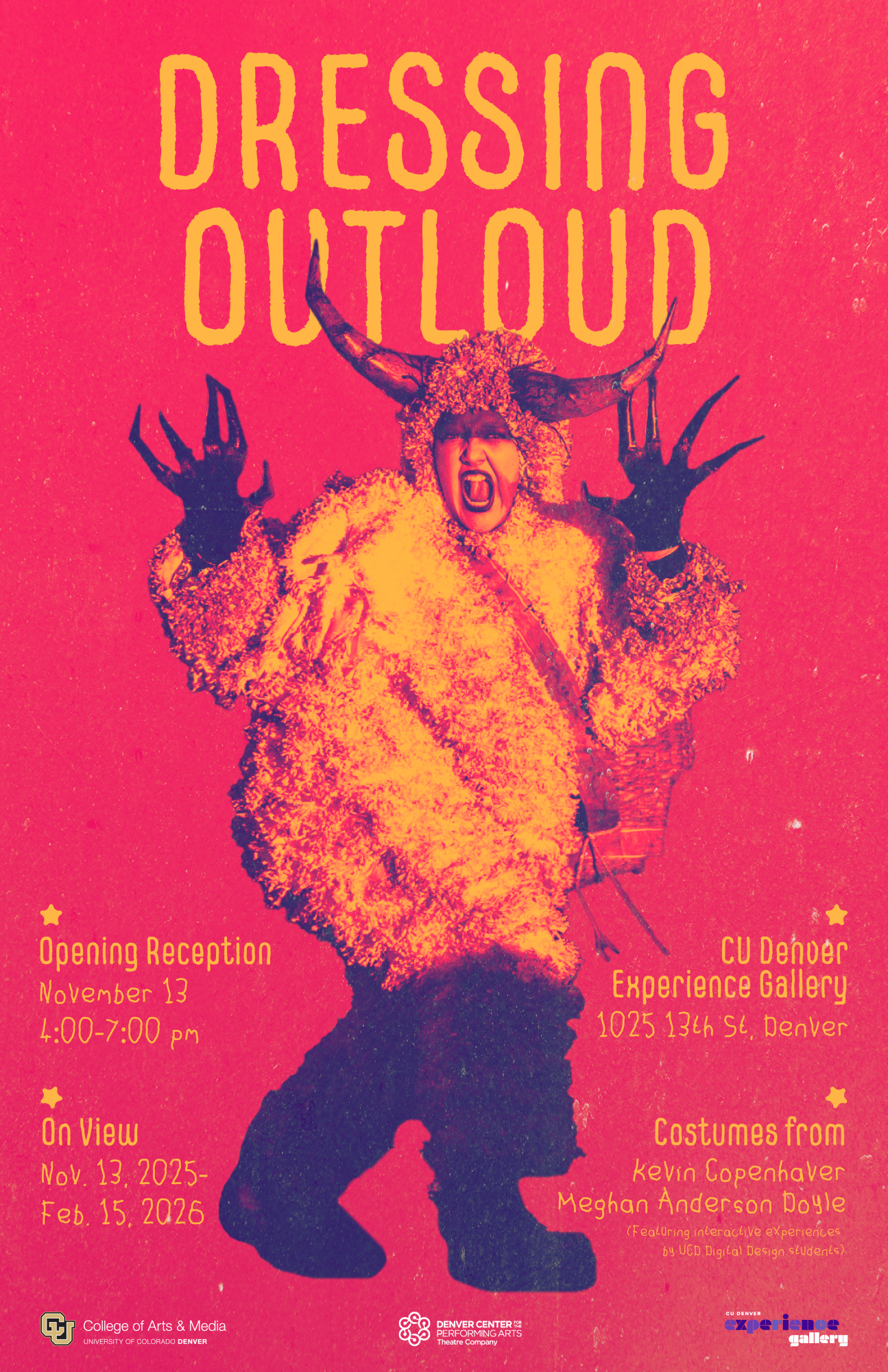
[Photo] Cropped Promotional Poster for
“Dressing Outloud.”
[Photo] Promotional poster for “Dressing Outloud.
Clothing carries stories. Seemingly little things such as the appearance of frayed hems or the stains buried deep within the composition of the fabric can reveal where someone has been and who they are. In costume design, those details take on a heightened meaning tohelp transform fabric into a character’s history and personality, making a narrative legible before a single line of dialogue is spoken.
“Dressing Outloud,” the exhibition currently inhabiting CU Denver’s Experience Gallery since mid-November 2025, brings attention to this idea by showcasing work by Meghan Anderson Doyle and Kevin Copenhaver, two designers at the Denver Center for the Performing Arts. This exhibit features a collection of different kinds of pieces, such as costumes utilized within company productions, in addition to Halloween costumes, burlesque pieces, and fashiongarments made entirely out of recycled materials, referred to as “trashion.” Like many other exhibits hosted by Experience Gallery, this installation also features work created by CU students, taking form through a series of digital interactive tablet displays that go hand in hand with the costumes by Doyle and Copenhaver.
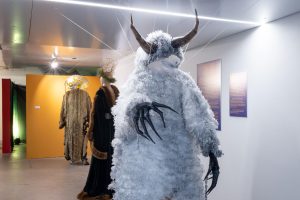
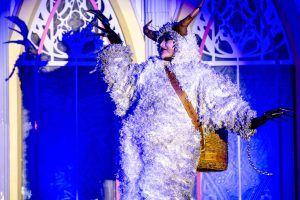
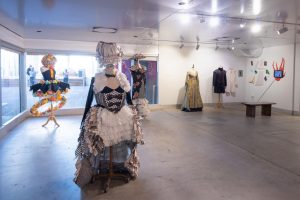
[Photo] “All I Want For Christmas Is You” by Meghan Anderson Doyle displayed in the gallery. (Photo Courtesy of Paul Wedlake)
CU’s Experience Gallery had previously collaborated with these two designers in late 2022 and early 2023 for a different costume exhibition titled “Behind the Curtain: DCPA Theatre Costumes Up Close” which featured the intricate details of different stage costumes, highlighting the process of how they are constructed and the materials used to create them. What makes “Dressing Outloud” distinctive from the previous show is the emphasis of Doyle and Copenhaver’s role as storytellers through costuming. Each piece in the gallery holds a different narrative weight, and viewers are invited to interpret and engage with the stories being presented to them through this form, whether they are familiar with the actual story or not.
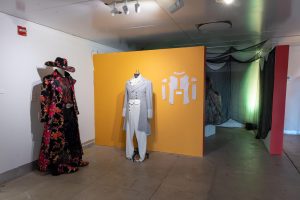
[Photo] Still from the gallery’s opening featuring some of Copenhaver’s work. (Photo Courtesy of Paul Wedlake)
Meghan Anderson Doyle describesthe voice a costume can have like “a treasure hunt to work through the script and learn about a character, and think through how those personality traits might develop into the overall costume.” She went on to elaborate that the voice speaks through the design by the intentional choices made through color, texture, fabric, choice, and silhouette, by saying if the character being designed for is “guarded and stern, the costume might be more structured and rigid. Whereas if they are more open and vulnerable, the clothing may be drapier and less buttoned up.” This attention to detail allows the costume to not only bring the character off the page of a script but also allows them to convey subtle nuances that may not be explicitly stated in the original writing. In turn, it also shapes how audiences understand that character before theyeverspeak.
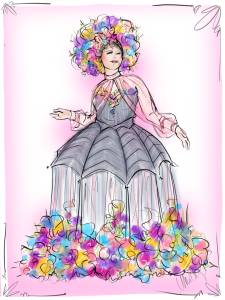
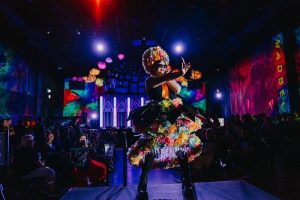
[Illustration] Original Rendering of ““If You Want The Rainbow, You’re Gonna Have To Put Up With The Rain.” (Illustration Curtesy of Meghan Anderson Doyle)[Photo] Doyle’s piece ““If You Want The Rainbow, You’re Gonna Have To Put Up With The Rain” on stage at Meow Wolf’s “Absolute Rubbish” Trashion Show. (Photo Courtesy of Becky Duffyhill @beckyduffyhill.creative)
That immediacy is where a costume’s power becomes especially apparent. Doyle points out that the audience often sees the character before they learn anything about them through dialogue or action, outlining that “the audience gets the opportunity to get in on the detective work of discovering the character through clothing.” In that sense, costumes offer viewers an immediate entry point into a character’s personality, status, and even occupation. In a gallery settinglike Experience, where the garments are removed from performance and the identity of someone wearing them, these visual cues become even more pronounced. This is particularly evident in Doyle’s “trashion“ pieces, Copenhaver’s burlesque works featured within the show, and the overall challenge of having to create characters and stories from the ground up told entirely through the costume.
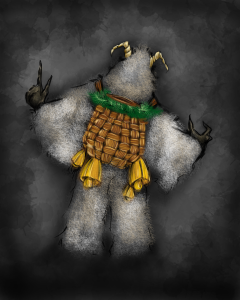
[Photo} Doyle’s piece “All I Want For Christmas Is You” on stage at Meow Wolf’s “Absolute Rubbish” Trashion Show. (Photo Courtesy of Melissa Bailey @melissabaileyphoto)[Illustration] Original Rendering of “All I Want For Christmas Is You.” (Illustration Courtesy of Meghan Anderson Doyle)
These pieces from Doyleare from a series of “trashion” runway shows hosted by Meow Wolf that bring together local artists to create fashion designs made from recycled, upcycled, and reclaimed materials, with a different theme being utilized per show. Doyle described that the prompt and the theme of the shows sparked her into “thinking about how to imagine that prompt in clothing and find a piece of music for the runway that tied it all together.” This emphasis on more concept-driven storytelling also changes the pace and priorities of the design process. On the idea of how the approach to design changes outside of traditional theatre, like within these “trashion” shows, Doyle explained that “it’s a different way of thinking and really relies on that first impression making a bold statement. When you only have 3 minutes on the runway, compared to 2-plus hours in a play, your design choices need to be strong and clear from the moment the music starts, and the model hits the runway.”
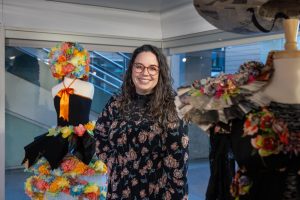
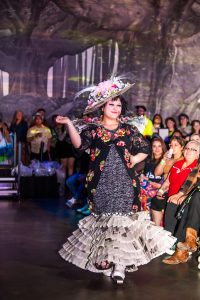
[Photo] Meghan Anderson Doyle and some of her work from the exhibition’s opening. (Photo Courtesy of Paul Wedlake)[Photo] Doyle’s piece “I’m Just A Girl” on stage at Meow Wolf (Photo Courtesy of Melissa Bailey @melissabaileyphoto)
Story continues below advertisement
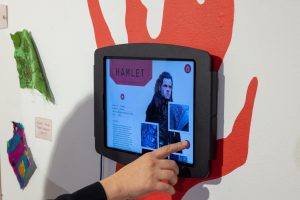
The intimacy of seeing each of Doyle and Copenhaver’s works outside of the stage is an aspect that the exhibition highlights, also extending beyond the physical garments and into the digital displays designed by students. Created in a digital design class led by Professor Darija Medic, the interactive components challenged students to translate the art form of costume design into something interactive for viewers to experience. With each of the student’s projects, such as one being a personality quiz to connect the viewer with a specific costume within the exhibition, a “Trash-It Yourself” textile game based on Doyle’s work, a scavenger hunt, and a display that takes the viewer through the design process, each adds a unique element that allows for a deeper understanding and appreciation of the pieces being shown.
[Photo] Visitors interacting with the digital displays. (Photo Courtesy of Paul Wedlake)
When asked about how she framed the challenge of translating costume design into an interactive form of digital media, Medic excitedly describes that “costumes are meant to be seen through how someone moves in them, they are brought to life on a stage through human manipulation and interaction.” She articulates thatin the previous exhibition with Doyle and Copenhaver back in 2022-23, Medic learned from the Gallery’s Coordinator and Interim Director, Andrew Palamara, that there was a bit of a gap between the static nature of how each piece was displayed and the “living characters that bring the costumes to life.” She shared the question with her class of how they would be able to create interactive pieces that also, in turn, created a story surrounding the costumes in a way that feels both reflective and playful. With this process, Medic spoke about how the students then voted on each of the ideas they brainstormed, and from there chose 4 main projects that they developed in groups.She also notes that throughout this design process, “interaction design goals such as accessibility, Gestalt principles (how we naturally organize visual elements), and usability heuristics were introduced on the level of technical implementation to apply best user experience design practices” toensure that the pieces students made were not only visually engaging but also user-friendly and accessible.
[Photo] Visitors interacting with the digital displays. (Photo Courtesy of Paul Wedlake)
As Medic explained, much of the students’ engagement with the costumes began well before the installation. Due to how the class started ideating without knowing exactly which pieces would appear within the exhibition, students built familiarity with the costumes through research rather than actual physical proximity. This is something that in tandem shifted how they later encountered the garments when students got to tour the costume shop at the Denver Center with Doyle. Medic emphasizes that this was a pivotal moment for themas they were able to see the scale, movement, and materiality of the designs firsthand in addition to asking questions directly to Doyle. That transition, from photos and descriptionsof each of the pieces to the tangible physical objects, deepened their attention to detail and sharpened their understanding of Doyle and Copenhaver’s storytelling processes, and was an aspect that each of the groups leaned into when creating their displays.
In an answer to a question about how the presence of student work in this exhibition adds to the overall experience of walking through the gallery, Medic spoke about the hope she has that the“presence of these projects inspires the gallery audience to explore the show in a more engaged and personal way.” Regarding that, she emphasized how each of the digital displays offer another way of seeing the pieces.“Imagine how different you see a costume after you have been paired with it through a personality quiz or how you start seeing everyday waste material after learning how the Krampus costume consists of coffee filters, cardboard, and soda tabs,” Medic said. With the other two displays she described how the costume process projectoffers “both an interactive timeline to experience the different stages of a costume making process and does a deep dive into 4 different costumes,” while the scavenger hunt “motivates people to closely look at details surrounding a costume through a gamified incentive to unlock new levels and win a candy prize.”
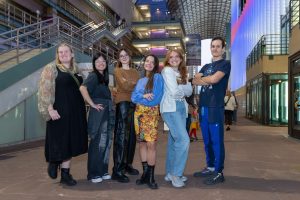
[Photo] Darija Medic with a few of the students who worked on the different digital instillations. (Photo Courtesy of Paul Wedlake)
Experience Gallery’s “Dressing Outloud”positions costume design as a form of narrative writing within itself. These costumes, seen up close in the gallery, with the ability to walk around most of the garments on display, the material intricacy of these pieces becomes especially striking.I, a CU Denver student and Sentry Design editor, actually had the honor of being the model for each of Doyle’s “trashion” designs within the runway shows at Meow Wolf,in addition to help curate this exhibition alongside Andrew Palamara and Darija Medic.
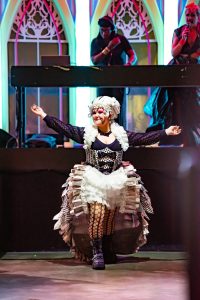
[Photo] Still of Doyle’s “Girls Just Wanna Have Fun” and other pieces from the gallery. (Photo Courtesy of Paul Wedlake)[Photo] Doyle’s piece “Girls Just Wanna Have Fun” on stage at Meow Wolf (Photo Courtesy of Melissa Bailey @melissabaileyphoto)
With the intricacies of each of them, they all tell an elaborate story that invites the audience to really dive deep and think about what kinds of characters inhabit these clothes. Especially within Doyle’s “trashion” pieces—from the 1000+ cut-up coffee filters used in her Krampus “All I Want For Christmas Is You” design, to the little details made out of catalogs, magazines, newspapers, and actual play script pages used within the structure and details of “Girls Just Wanna Have Fun.” The designs are even more incredible and astounding up close when gallery visitors really let their eyes graze over all of the tiniest details.By presenting Doyle and Copenhaver’s work outside of performance and accompanying it with student-created interactive experiences, “Dressing Outloud,”open through the 15th of February, invites its audience to slow down, look closely, and interpret what clothing can communicate. In doing so, this exhibition situates costume design within a larger world and visual arts landscape, reminding people who visit the gallery, that storytelling is not only literal through stage, screens, and words, but also through materials, processes, and even just the act of looking closely at the little things.
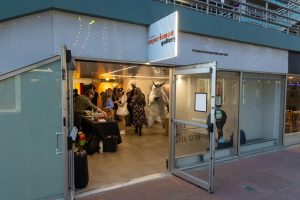
[Photo] Experience Gallery on opening night. (Photo Courtesy of Paul Wedlake)
Your donation will support the student journalists of University of Colorado Denver. Your contribution will allow us to purchase equipment and cover our annual website hosting costs.
Maya Rae Taylor is an undergraduate student currently majoring in both Illustration and Creative Writing. Although she currently holds the position of Design Editor, she began her career at The Sentry late 2022 as a Freelance Illustrator while being slowly indoctrinated (through peer pressure) into a Freelance Writer position in addition to it. She loves that art can spark empathy and new ways of thinking, hoping that her work both within The Sentry and outside of it challenges the viewer to find some aspect of themselves within someone else’s story.
Maya is often enthusiastically tasked with drawing really awesome (2025 Spring Issue Cover) or incredibly stupid (Jesus Milo/”Creation of Adam” Milo & Turkey) illustrations for The Sentry.

![[PHOTO] Front facade of Emmanuel Gallery](https://sentrynewspaper.com/wp-content/uploads/2026/04/Screenshot-2026-05-08-142049.png)
![[PHOTO] Cover of The Pearl's website](https://sentrynewspaper.com/wp-content/uploads/2026/05/Screenshot-2026-05-08-141826-1200x447.png)
![[PHOTO] Activist Dan Strandjord with a sign that read "DIFFERENT BODIES SAME RIGHTS"](https://sentrynewspaper.com/wp-content/uploads/2026/05/image_123650291.jpg)
![[ILLUSTRATION] Satellite orbiting the moon](https://sentrynewspaper.com/wp-content/uploads/2026/05/Final_Artemis-II_Samantha-Tilly_Publish-4.22_page-0001-857x1200.jpg)
![[PHOTO] Cleat on soccer ball](https://sentrynewspaper.com/wp-content/uploads/2026/04/connor-coyne-OgqWLzWRSaI-unsplash-1-900x1200.jpg)
![[Illustration] Child holding a MYDenver Card.](https://sentrynewspaper.com/wp-content/uploads/2026/04/FINAL_DenverLibrary_MikaylaRondon_03.17.2026-857x1200.png)
![[PHOTO] Still from Sheep Detectives trailer](https://sentrynewspaper.com/wp-content/uploads/2026/05/Screenshot-2026-05-04-120641-1200x583.png)
![[Illustration] House with "ART" and "TRUST" on the sides.](https://sentrynewspaper.com/wp-content/uploads/2026/04/FINAL_CASTFund_MikaylaRondon_03.17.2026-857x1200.png)
![[Photo] Two artists preform on stage.](https://sentrynewspaper.com/wp-content/uploads/2026/04/battleotbands-1-1200x853.jpg)
![[Illustration] Leon S Kennedy and Grace Ashcroft from Resident Evil 9 standing back to back.](https://sentrynewspaper.com/wp-content/uploads/2026/04/FINAL_Resident_Evil_9_Elora_Dodrill_03.25.26-857x1200.png)
![[PHOTO] Marquis of Boulder Theater](https://sentrynewspaper.com/wp-content/uploads/2026/03/simon-goetz-JPesrLozzlM-unsplash-1200x803.jpg)
![[Illustration] Spiff off Steven Espada Dawson's book cover; a man colored with patterns with pamphlets reading "POEMS" floating around them.](https://sentrynewspaper.com/wp-content/uploads/2026/03/FINAL_PoetryReading_MikaylaRondon_03.11.26-857x1200.png)
![[ILLUSTRATION] Spotlight shines on person hunched over in a chair](https://sentrynewspaper.com/wp-content/uploads/2026/05/FINAL_Lynx_Crossing_Elora_Dodrill_04.22.26-857x1200.png)
![[Illustration] A krampus hand grabs a globe with the Tivoli inside.](https://sentrynewspaper.com/wp-content/uploads/2025/12/FINAL_Christkrindlmarket_EllanorFader_11.26-1200x857.jpg)


![[Photo] Cropped Promotional Poster for
"Dressing Outloud."](https://sentrynewspaper.com/wp-content/uploads/2026/01/Screenshot-2025-10-28-at-3.07.16-PM.png)

![[PHOTO] Two people with a lot of tattoos in black and white](https://sentrynewspaper.com/wp-content/uploads/2026/03/FINAL_FridayThe13th_MontyBanks_03.2.26-960x1200.png)